|
2008 Newsletters |
|
MONTH
Click link to read... |
SUBJECT
|
|
Summer |
Summertime Tips - Common Eye
Problems |
|
Fall |
Horse First Aid Kit -
Poisonous Plants in the
Pasture |
|
Winter |
Tooth Care - CEM - Equine
Lymphoma |
◄back to Newsletter Page
Summer
2008 Newsletter
Well summer is finally in full swing.
Hopefully everyone is enjoying the nice
weather and spending some quality time
with your horses. Remember to deworm
your horses in August/September with
Ivermectin.
A BIG THANK YOU!
We want to take this opportunity to
thank all of you for making Melissa feel
welcome as a part of the practice. We
understand that it can be difficult to
have a unfamiliar doctor work on your
horse, but everyone has been very
willing and welcoming and this is very
much appreciated. Melissa has enjoyed
meeting all of you and your horses and
she looks forward to continuing to
provide the best care and medicine to
everyone.
1. Make sure that your horses always
have access to fresh, clean water at all
times. Dehydration can lead to all sorts
of problems.
2. Flymasks are helpful, but make sure
they fit well and are not causing
abrasions on skin or eyes.
3. On hot days the best way to cool out
a hot horse after exercise is to douse
them in cold water and then scrape it
off right away. Do this 5-10 times in a
row and it will help to cool them down
faster. The reason for this is as soon
as the water contacts their skin it will
quickly get heated up and lose its
cooling affect. Also run cold water on
their jugular vein in their necks or on
the large veins on the insides of their
legs. This will also help to cool them
off.
4. Fans can be very helpful in reducing
bugs and keeping your horse cool.
Position them safely in order to prevent
fan "haircuts".
5. Flysprays can be helpful but remember
to dilute concentrated flyspray because
to strong a solution can blister a
horses skin.
We thought it would be a good idea to
write about something that is
encountered quite a bit during the
summer. Medical problems of the equine
eye seemed like a good subject.
EYE ANATOMY
(Pieces/parts)
Cornea: The thin transparent
layer that covers the front of the eye.
This outer covering of the front of the
eye is only 0.6 to 1 mm thick!!
Sclera: The white part of the
eye. This is what you see when your
horses see us coming!
Conjunctiva: The pink soft tissue
on the inner side of the eyelids and
surrounding the entire eye. Irritation
of this area is called conjunctivitis.
Iris: The colored part of the
eye. The iris is actually a muscle that
changes the size of the pupil in
response to bright or dim environments
to affect how much light reaches retina.
In response to pain this muscle can
contract (cramp) and this will cause
more discomfort in the eye. This is why
we will use atropine in painful eyes
because this drug relaxes those muscles
and allows the pupil to dilate.
Pupil: The hole in the center of
the iris. The size of the pupil if
controlled by the iris. A constricted
pupil is one that is very small while a
dilated pupil is when the hole is wide
open.
Lens: The round transparent
structure behind the iris through which
light is focused. This is what allows us
to see things clearly rather than being
fuzzy and unfocused.
Retina: The back of the eye which
contains the cells which receive light
and transmit that signal to the brain.
Optic Nerve: This nerve is the
information pathway for all visual
signals. This nerve transmits the
information to the brain.
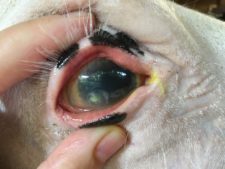
Corneal ulcers:
Scratches to the cornea are one of the
most common injuries that occur.
Injuries to the cornea are usually very
painful. Signs of pain that your horse
may display include squinting the eye,
swollen eyelids, watering eyes or
discharge from the eyes, and a cloudy
appearance to the normally clear part of
the eye. The cornea takes some time to
heal therefore we like to put these
horses on medications and antibiotics to
protect the eye while the scratch or
ulcer heals. Ulcers should be treated
promptly because if they get infected
this can lead to many problematic
complications.
Eyelid trauma:
Tears or lacerations to the eyelids also
occur fairly frequently whether from
catching the eyelid on something in the
stall, the trailer or pasture. These
lacerations should be sutured closed as
soon as possible to ensure that the
eyelid heals correctly and continues to
provide adequate coverage and protection
to the eye. If eyelid lacerations are
not sutured they will heal in with scar
tissue. This scar tissue may rub on the
eye and cause recurring ulcers.
Equine Recurrent Uveitis (ERU):
Also called "moon blindness," this
condition is most common in appaloosas.
Uveitis simply means inflammation of the
interior structures of the eye. The
reason it is called "recurrent" is
because affected horses tend to have
"attacks" or relapsing episodes of this
condition. Unfortunately the exact cause
is unknown. Signs of uveitis include a
squinty painful eye, a cloudy or blue
color to the cornea, or corneal ulcers.
Because the eye becomes painful, your
horse might try to rub the eye and cause
a corneal scratch or ulcer so sometimes
this can be the first sign of a problem.
This condition can not be cured but must
be managed with steroids and
antibiotics.
Why do horses hurt their eyes??
Because horses are very talented at
hurting themselves in ways we can not
even imagine! One of the main reasons
the horse eye is susceptible to injury
is that their eye is placed lateral or
to the outside of the head as opposed to
the human eye that is placed more
centrally. This gives the horse the
advantage of a much greater field of
vision but the eye is also more
vulnerable to trauma. Fly season also
causes a great increase in the number of
eye problems in the horse. The constant
rubbing and shaking to rids themselves
of flies can lead to injuries.
Why should I call if I notice that my
horse's eye is squinty, swollen, or an
odd color?
Although an injury to the eye may look
relatively minor, these small issues can
become much larger if they are not
treated quickly. Because the outer
protective layer of the eye, the cornea,
is so thin, any damage to it will allow
bacteria and fungi to get into the eye
and cause a very serious infection. If
the infection is severe enough the eye
could be lost. Eye problems always do
better when treated promptly.
Have a great and healthy summer,
Dr's Paul and Melissa
▲back
to top
Fall 2008
Newsletter
Its getting cooler and the leaves are
changing color! Must be time for another
newsletter!
Remember to
deworm your horses in Nov/Dec with Quest
Plus/Combicare.
Here's a list of some good items to
include in your own horse first-aid kit.
Some items are available only from the
veterinarian (that would be us!) while
others can be found at your local co-op
or farm store.
Bute (phenylbutazone) paste
Banamine paste
Betadine solution and scrub
Nitrofurasone ointment (sometimes called
Furacin)
Bandaging materials- vetwrap, cotton or
quilt bandages, polo wraps
Digital Thermometer (normal horse temp
98.5-101.5 F)
Flashlight
Epsom salts
Duct Tape
Heavy Duty Scissors
Fly Mask
Some important
notes: If you are
inexperienced at bandaging horse legs,
please CALL before deciding to bandage
something. Bandaging a leg incorrectly
or too tightly can cause significant
injury to the horse.
If you have chosen to give banamine for
a colicky horse, CALL US to let us know
what is going on. Even if you think it
is relatively minor.
|
Poisonous Plants in the
Pasture |
Here’s a list of some of the more common
toxic plants found in the Midwest that
could cause a problem in your pasture or
hay.
Red Maple
trees- Red Maple trees are
common in Minnesota as shade trees. The
danger comes in the fall when the leaves
wilt and fall or the tree trimmings are
left in pastures for horses. As little
as 2 lbs. of leaves can cause toxicity
in an adult horse. The toxin leads to
destruction of the horse’s red blood
cells causing signs such as weakness,
jaundice, colic, and red or brown
colored urine.
Common
Cocklebur- Cocklebur is found
commonly in pastures in Minnesota. More
toxic as an immature plant than as the
mature bur. Plants can be eliminated by
mowing or hand-pulling. A specific toxic
dose has not been reported. Horses could
show signs of depression, weakness,and
muscle twitching within hours of eating
the plant. Untreated exposure or eating
large amounts can lead to fatal liver
damage. Thankfully horses will rarely
ingest this plant.
Oak trees-
Toxins can be found in the
acorns, flowers, and leaf buds of the
oak tree. The toxin in this tree causes
abdominal pain and affects the kidney
leading to signs of colic, straining to
defecate, frequent urination, black
feces, and increased heart and
respiratory rate.
Hoary Alyssum-
Hoary alyssum is commonly found growing
in pastures and hay fields of the
northern states including Minnesota.
Most toxic exposures occur from baled
hay that contains the weed. Horses show
signs of toxicity within hours of
exposure including fever, limb edema
(stocking up), colic, and laminitis.
White Snake
Root- A fairly common plant
in the Midwest, white snake root remains
toxic year-round and can cause a problem
in both the pasture and stored feed.
Poisoning most often occurs in the fall
when other pasture has been exhausted.
The weed likes to grow in shady or
wooded areas. Toxic levels build-up over
a few weeks, leading to clinical signs
of incoordination, muscle tremors,
weakness, increased heart rate, profuse
sweating, and eventually heart failure.
Bracken Fern-
A weed that grows in overgrazed
pastures, Bracken Fern produces a toxin
that causes neurological disease after
building up in the body for a month or
more. Signs include weight loss,
staggering, incoordination, muscle
tremors, and weakness.
Prevention of
pasture poisoning- Most
horses WILL NOT prefer to eat these
plants. Most poisonings occur when other
forage is exhausted and a horse finds
alternative sources of food or something
to chew on to cure boredom.
|
Therefore the keys to
preventing poisoning are:
- to ensure these
plants/trees are not found
in your pasture or field
- to provide adequate forage
especially in times of
drought
- purchase hay from a
reputable source
- reduce overgrazing of
pastures
|
For more information and photos of these
plants, visit the website:
www.extension.umn.edu/horse
Enjoy the cool fall weather,
Dr.
Paul, Dr. Melissa
▲back
to top
Winter 2008 - 2009 Newsletter
Current Issues In Equine Medicine
We are in the heart of winter....BRRRR!
Don't forget to check under your horse's
blanket and make sure they are
maintaining a good weight and staying
healthy. Watch out for icy spots and
provide plenty of water. Most
importantly try to stay warm!!
Remember to deworm your horses in
February with Panacur/Safeguard.
|
Winter is the time for
floating your horse's teeth!
|
Your horse's
teeth have a tendency to form sharp
points which can cut the inside of the
horses mouth, interfere with the bit,
and cause uneven wear which can lead to
earlier loss of teeth and difficulty
eating. We recommend that your horse
have its teeth checked at least once per
year for abnormalities that may require
floating. Starting to pay attention to
your horse's teeth when they are young
will prevent them from having major
abnormalities in the middle to later
years, prolonging the life of their
teeth and the horse!. Dr. Paul and Dr.
Melissa use the latest technology and
training to assess your horse's mouth
and keep it as healthy as possible.
Concerns about
floating teeth: There are many
different philosophies of equine dental
care. Non-veterinarians who offer to
float teeth may do a good job, but if
they are using sedatives without
veterinary supervision, they do so
illegally and without thorough knowledge
of how to use those drugs. Some
individuals believe that all horses
require aggressive floating of both
cheek teeth and incisors. Excessive
floating can permanently damage a
horse's teeth as well as cause
significant discomfort. If your horse is
not able to eat his normal diet hours or
days after having his teeth floated,
this is abnormal. "Do no harm" is part
of the veterinary oath that we always
try to live by.
|
Contagious Equine
Metritis (CEM)
|
Many of you
may have read in the latest equine
journals or gossip mills about an
outbreak of Contagious Equine Metritis.
The information out there might be a
little confusing so we wanted to set the
record straight on what is going on and
what you need to know.
What's been happening? In December 2008,
the State of Kentucky confirmed a case
of contagious equine metritis (CEM) in a
quarter horse stallion residing on a
Kentucky farm. Since then, 11 stallions
(located in Indiana, Kentucky, Texas,
and Wisconsin) have been confirmed as
positive for CEM by USDA’s National
Veterinary Services Laboratories (the
government agency who is overseeing this
outbreak). Officials are still not sure
which stallion caused the outbreak and
the investigation continues.
In addition to the stallions, the
locations of a number of CEM-exposed
horses have also been confirmed. All CEM-positive
horses, and all exposed horses that have
been located, are being held under
quarantine or hold. Testing and
treatment protocols are being put into
action for all located horses. An
exposed horse is one that was bred to a
CEM-positive horse, either naturally or
via artificial insemination, or one that
is otherwise significantly linked to a
CEM-positive horse, as determined by
State and Federal animal health
officials.
The above information was obtained from
the USDA-Aphis.
What is CEM?
CEM is caused by the bacteria Tayorella
equigenitalis. The disease is sexually
transmitted and can be passed from horse
to horse through natural breeding,
contaminated instruments, or semen used
for artificial insemination. Signs of
the disease are purulent vaginal
discharge, abortion and infertility in
mares. Stallions typically show no signs
of infection. Both stallions and mares
can become chronic carriers of CEM. CEM
is sometimes difficult to diagnose as
mares will only test positive for the
disease for a short period of time after
being infected. Typically the disease is
traced via diagnosis of the stallion and
then location of all mares exposed to
that stallion.
Can CEM be
treated? Yes. CEM can be treated
with antibiotics and disinfectants.
Horses that have tested positive for CEM
must be quarantined until a treatment
protocol is complete and they have
tested negative for the disease.
Equine Lymphoma- a cancer that affects
all ages
What is equine
lymphoma? Lymphoma actually
describes a number of variations of
abnormal development of blood and/or
immune system cells. This type of cancer
is different because both very young and
old horses can be affected. Signs of the
disease can be very apparent or require
a bit of a diagnostic hunt to find.
The most common
signs of the disease: chronic
weight loss, poor doers, respiratory
illness, and enlarged lymph nodes. Other
signs include chronic low grade colic,
signs of decreased ability to clot
blood, development of skin or abdominal
masses.
How is this
disease diagnosed? Blood tests
performed by the veterinarian will often
reveal abnormally low levels of red
blood cells, white blood cells, and
platelets. Additionally, skin masses or
enlarged lymph nodes can be biopsied to
look for abnormal cells.
Treatment?
Sadly, this type of cancer is not very
treatable. Horses tend to continue to
develop more problems with weight,
breathing or comfort. Lymphoma does tend
to be slowly progressive so some horses
may live with the disease for months or
years without showing any signs.
Should I be
worried? Thankfully, cancer in
general does not occur very frequently
in horses. Most weight loss or
respiratory issues are caused by other
issues, but it is good to be aware of
some of the less common diseases that
can become an issue.
Hang in there, the temperatures will
rise in no time (we hope!),
Dr.
Paul, Dr. Melissa
▲back
to top |